


What Is the SMAS Layer? A Simple Guide to Non-Surgical Face Lifting in Adelaide
When people start researching non-surgical face lifting, they often see the term “SMAS” beside treatments such as Ultherapy Prime and Ultraformer MPT. It can sound highly technical, but the basic idea is simple: your face has several layers, and each layer contributes differently to firmness, movement, texture and shape.
Understanding those layers matters because jawline softening or facial laxity does not have one single cause. For one person, deeper structural support may be the main concern. For another, the visible change may relate more to skin quality, facial volume or muscle function. A useful consultation therefore begins with the concern and the anatomy, rather than choosing a device from a list.
The quick answer: what does SMAS mean?
SMAS stands for the superficial musculoaponeurotic system. It is a fibrous network beneath the skin and superficial fat that connects with facial muscles and surrounding connective tissues. Its structure is not identical across every part of the face. It helps transmit facial movement and contributes to the support of facial contours.
The SMAS is also familiar in facial surgery because surgeons may work with this deeper support system during certain facelift procedures. That does not mean a non-surgical treatment produces the same change as surgery. Energy-based treatments and surgery work in different ways and have different limits, risks and recovery requirements.
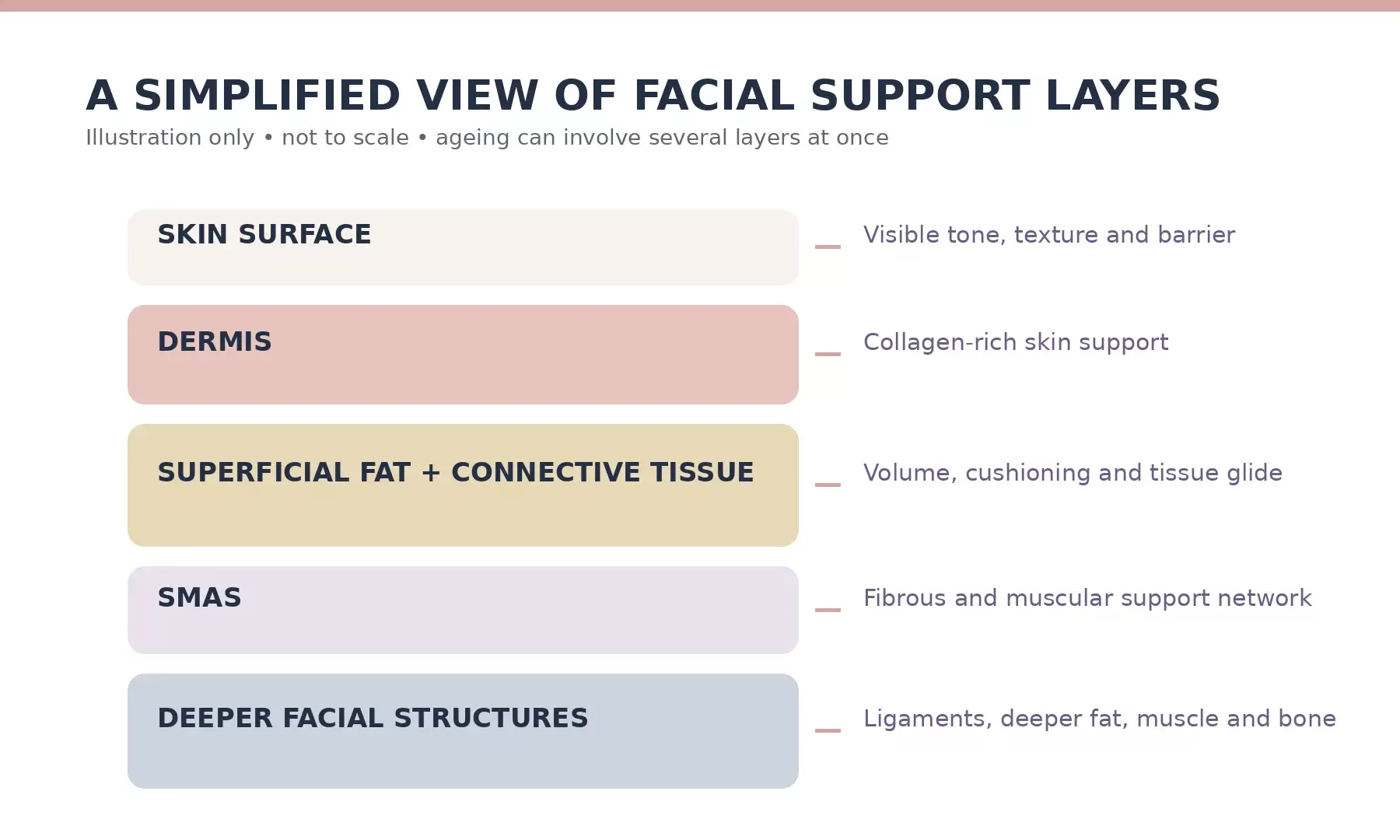
Why facial ageing is a multi-layer process
Visible ageing is rarely limited to one layer. Over time, several changes can occur together:
- Collagen and elastin within the skin may decline, contributing to fine lines and reduced firmness.
- Fat compartments can change in volume and position, altering facial transitions and support.
- Ligaments and connective tissues may provide less resistance to downward movement.
- Muscle activity and tone can influence facial expression and contour.
- Bone structure changes gradually with age and can affect the framework supporting the soft tissues.
- Sun exposure can add pigmentation, uneven tone and surface texture changes that are separate from laxity.
This is why two people who both describe “sagging” may need very different plans. Treating deeper tissue will not directly remove freckles, and improving skin texture will not necessarily correct a meaningful loss of structural support.
Why “deeper” does not automatically mean “better”
Treatment depth should match the main concern. More energy, a deeper setting or a more expensive treatment is not automatically more appropriate. Facial anatomy, tissue thickness, treatment area, previous procedures, medical history and the degree of laxity all influence suitability.
For mild to moderate laxity, a non-invasive treatment may support gradual tightening or improved definition. When there is substantial excess skin or a person wants the degree of repositioning associated with surgery, a non-surgical option may not meet that goal. A responsible consultation should explain both the potential benefit and the limitation.
How focused ultrasound relates to deeper facial support
Focused ultrasound treatments deliver energy to selected depths beneath the skin without making an incision. The controlled thermal response can initiate collagen remodelling over time. Research reviews of microfocused ultrasound report improvement in mild to moderate facial laxity, while also noting variation in study methods and the need for stronger objective evidence. Results differ between individuals.
Ultherapy Prime
Ultherapy Prime combines focused ultrasound with real-time imaging. The imaging allows the practitioner to view tissue layers during treatment and plan energy delivery according to the treatment area and individual anatomy. In Australia, the Ulthera system is indicated for non-invasive lifting of the eyebrow and lax tissue beneath the chin and on the neck, and for improving lines and wrinkles on the décolletage.
Ultraformer MPT
Ultraformer MPT is a focused ultrasound platform designed for skin tightening and lifting. It offers different cartridges and delivery modes so treatment can be adjusted for the area and the treatment plan. It may be considered when targeted face, jawline, neck or body contour concerns are being assessed. Device choice and treatment settings should follow an in-person assessment.
Ultherapy Prime and Ultraformer MPT should not be treated as interchangeable simply because both use focused ultrasound. They differ in platform design, treatment delivery and practitioner workflow. BalaBala already has a separate treatment page for each device and a comparison guide for readers who want more detail; this article focuses on why anatomy and treatment depth matter.
What about the dermis and facial muscles?
The SMAS is only one part of the picture. BalaBala also uses technologies selected for other treatment goals and tissue levels:
- Thermage FLX uses monopolar radiofrequency and is commonly considered when dermal firmness, skin quality and broader tightening are priorities.
- EMFACE combines technologies intended to support facial muscle function and the overlying tissues, so it may be considered when muscle support forms part of the treatment goal.
- Laser and light treatments may be more relevant when pigmentation, redness or texture is the main concern rather than deeper laxity.
Some clients may be suitable for a staged, multi-layer plan. Others may need only one carefully selected treatment. Combining technologies is a clinical decision, not a requirement for a good result.
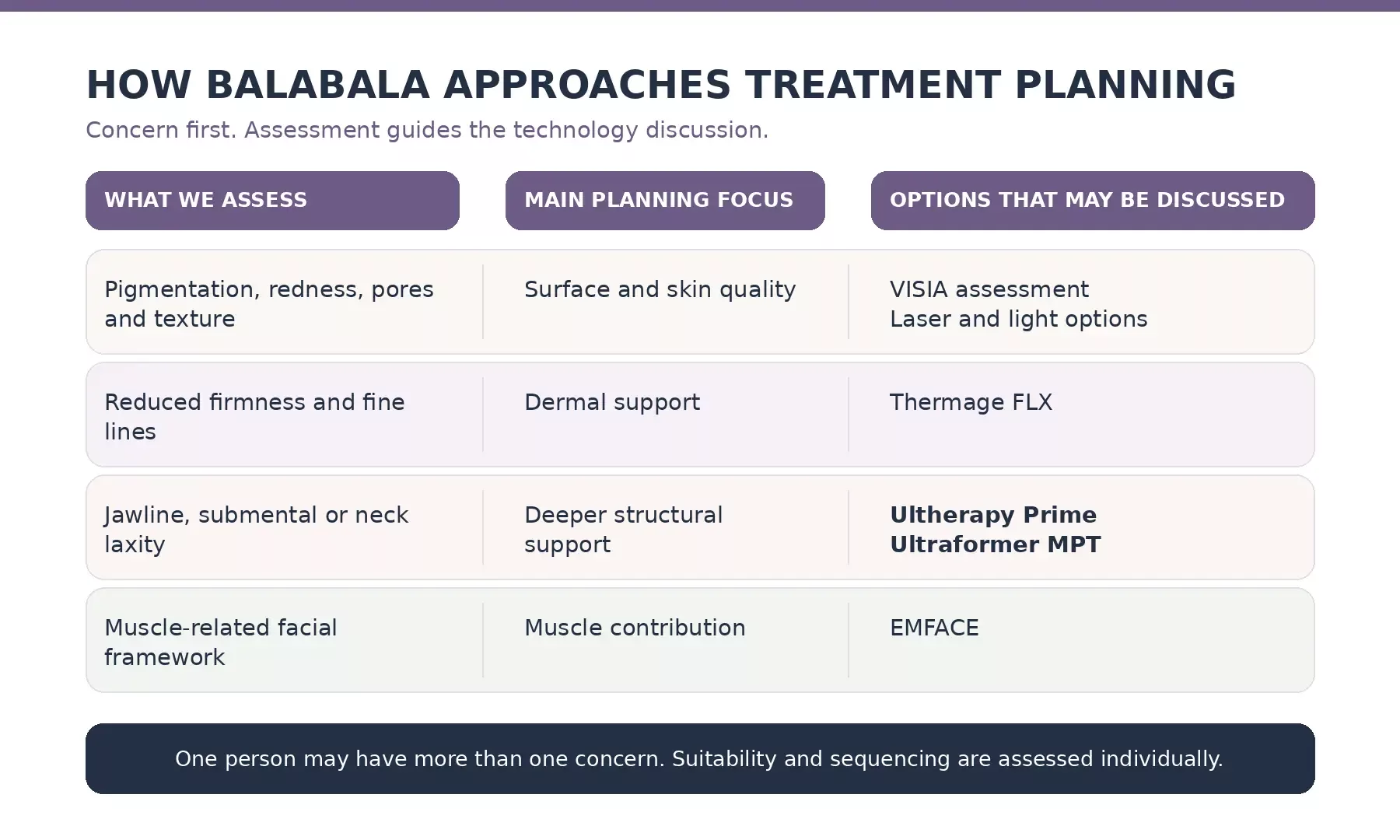
Where VISIA skin analysis fits—and where it does not
At BalaBala Laser Clinic, a consultation can include VISIA skin analysis to document visible and subsurface features such as pigmentation, redness, pores and texture under consistent imaging conditions. This information helps separate surface concerns from deeper lifting concerns and provides a baseline for future review.
VISIA does not directly show the SMAS and does not replace a hands-on assessment of facial anatomy, skin laxity or medical suitability. The value comes from combining imaging with a discussion of your priorities, examination of the treatment area and review by an appropriately qualified practitioner.
What should a good skin-lifting consultation assess?
- Which change bothers you most: skin texture, laxity, jawline definition, neck tissue, volume change or muscle-related contour?
- Whether the concern is mainly superficial, dermal, structural or a combination.
- Your skin condition, medical history, medications and previous aesthetic procedures.
- Your preferred level of downtime, comfort considerations, budget and treatment timeline.
- What improvement is realistic, how long change may take and when photographs or review appointments are useful.
- Whether another treatment, no treatment or a surgical opinion would better match your goal.
Who may consider a non-surgical lifting assessment?
An assessment may be useful for adults noticing early to moderate jawline softening, mild lower-face or neck laxity, brow heaviness or a gradual reduction in skin firmness. Suitability cannot be decided by age alone. People with certain medical conditions, active skin problems, implanted devices or other contraindications may need a different plan or further clearance, depending on the technology considered.
Temporary effects such as redness, swelling, tenderness, tingling or altered sensation can occur with energy-based treatments. The type and likelihood of side effects vary by device, treatment area and individual factors. Your practitioner should explain the relevant risks and aftercare before you consent.
A personalised approach to skin lifting in Adelaide
BalaBala Laser Clinic offers Ultherapy Prime, Ultraformer MPT, Thermage FLX and EMFACE within one Adelaide CBD clinic. The advantage of having several technologies is the ability to assess which layer and treatment goal should take priority. The starting point remains the consultation, because a device is useful only when it matches the concern, anatomy and expectations of the person being treated.
If you are considering non-surgical face lifting or skin tightening in Adelaide, book a skin consultation at BalaBala Laser Clinic. Our team can assess your skin, discuss the changes you have noticed and explain which options may be appropriate for you.
Frequently asked questions
Is the SMAS the same as the skin?
No. The SMAS is a deeper fibrous and muscular support network beneath the skin and superficial fat. The skin itself contains several layers with different functions.
Can a non-surgical treatment lift the SMAS like surgery?
Focused ultrasound can deliver energy to selected deeper tissue levels and may support gradual tightening in suitable patients. It does not remove excess skin or reproduce the tissue repositioning performed during surgery.
Is Ultherapy Prime or Ultraformer MPT better for the SMAS?
There is no universal answer. Both are focused ultrasound platforms, but they differ in their technology and treatment workflow. Suitability depends on the area, anatomy, degree of laxity, comfort considerations and practitioner assessment.
Does VISIA show the SMAS?
No. VISIA helps document surface and subsurface skin features such as pigmentation, redness, pores and texture. It supports treatment planning but does not directly image the SMAS.
How long does a non-surgical lifting result take to develop?
Many energy-based treatments rely on collagen remodelling, so change is usually gradual rather than immediate. The timeline varies by treatment and person and should be discussed during consultation.
Important information
This article provides general educational information only and is not a substitute for personalised medical advice. Suitability, risks, benefits, recovery and expected outcomes vary between individuals and treatments. An in-person consultation with an appropriately qualified practitioner is required before treatment. No specific outcome can be guaranteed.