


Ice Pick, Boxcar and Rolling Acne Scars: Why treatment must match the scar type
Treatment Must Match the Scar Type
Acne can leave several different changes behind: flat red marks, brown pigmentation, enlarged-looking pores, shallow depressions, deep pits or raised scars. They are often grouped together as “acne scarring”, but they do not involve the same structure and should not automatically receive the same treatment.
The most common depressed acne scars are classified as ice pick, boxcar and rolling scars. A person can have more than one type at the same time, along with post-inflammatory erythema or pigmentation. That is why responsible acne-scar treatment begins with assessment rather than choosing a laser or skin-needling package from a menu.
At BalaBala Laser Clinic in Adelaide, the first step is to separate active acne from post-acne marks and true textural scarring, assess skin type and healing history, and determine which concerns can reasonably be treated in-clinic and which may need medical referral.
The Short Answer
Ice pick scars are narrow and deep. Boxcar scars are wider depressions with more clearly defined edges. Rolling scars create broader, wave-like depressions and may be tethered to deeper tissue. Because these structures differ, no single treatment is appropriate for every scar.
Fractional resurfacing and radiofrequency microneedling may help selected atrophic scars, while deep ice pick scars or significantly tethered rolling scars may need procedures such as TCA CROSS, punch techniques or subcision from an appropriately qualified medical provider. Flat red or brown marks are not the same as textural scars and require a different plan.
Is It an Acne Scar, an Acne Mark or an Enlarged Pore?
Real-skin examples: flat redness, flat pigment, visible follicular openings and true depressions may coexist, but they are not the same structural problem. These are licensed educational images, not BalaBala patients or treatment results.
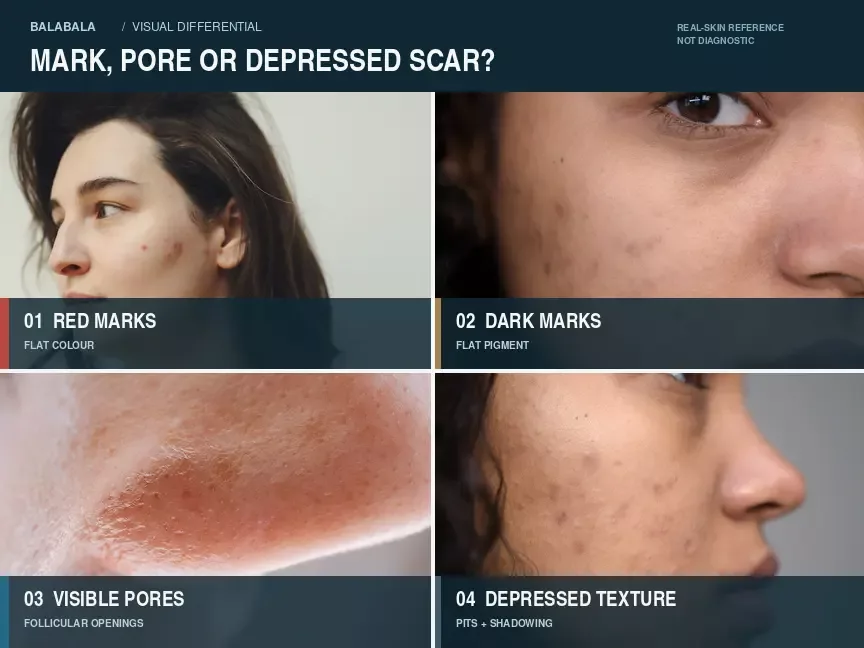
Before comparing scar types, it helps to decide whether the visible concern is actually a scar.
Concern | Typical appearance | What has changed | Why the distinction matters |
Active acne | Inflamed bumps, pustules, cysts or tender nodules | Ongoing follicular inflammation | New scarring can continue while acne is active; medical acne management may need to come first |
Post-inflammatory erythema (PIE) | Flat pink, red or purple marks | Small surface blood vessels and vascular change | Vascular or light-based treatment may be considered; resurfacing alone does not target the main cause |
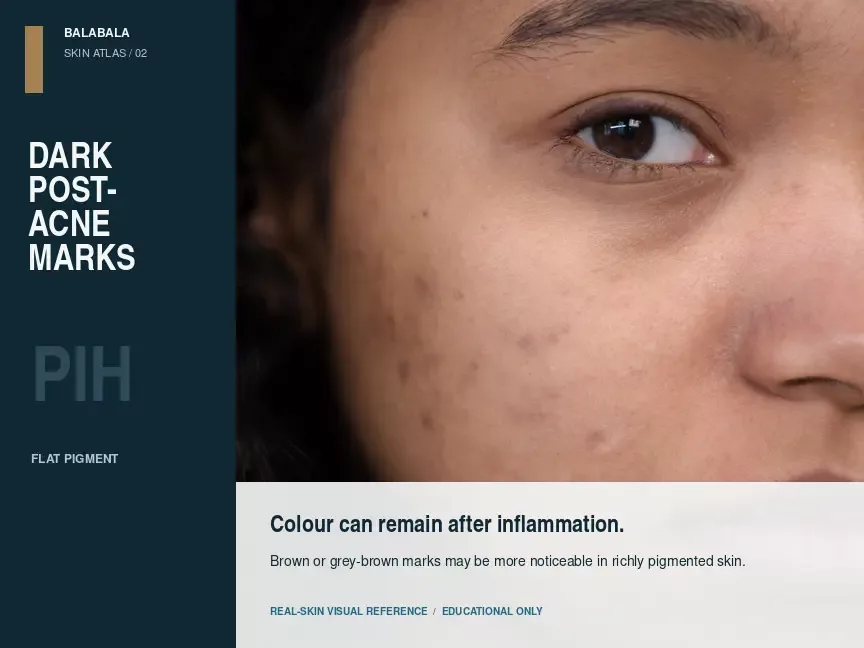
Post-inflammatory hyperpigmentation (PIH) | Flat tan, brown, grey-brown or dark marks | Excess melanin after inflammation | Pigment management and inflammation control are needed; aggressive treatment can worsen PIH |
Enlarged pores | Repeated small openings, often around the nose and inner cheeks | Visible follicular openings, oil activity and surrounding support | Pores may improve with collagen-focused treatment but cannot be permanently “closed” |
Atrophic acne scars | Depressions that create shadows in side lighting | Loss or remodelling of dermal collagen | Treatment needs to match depth, edges and tethering |
Raised scars | Firm bumps extending above the surrounding skin | Excess scar tissue, including hypertrophic or keloid change | These require a different medical assessment from depressed scars |
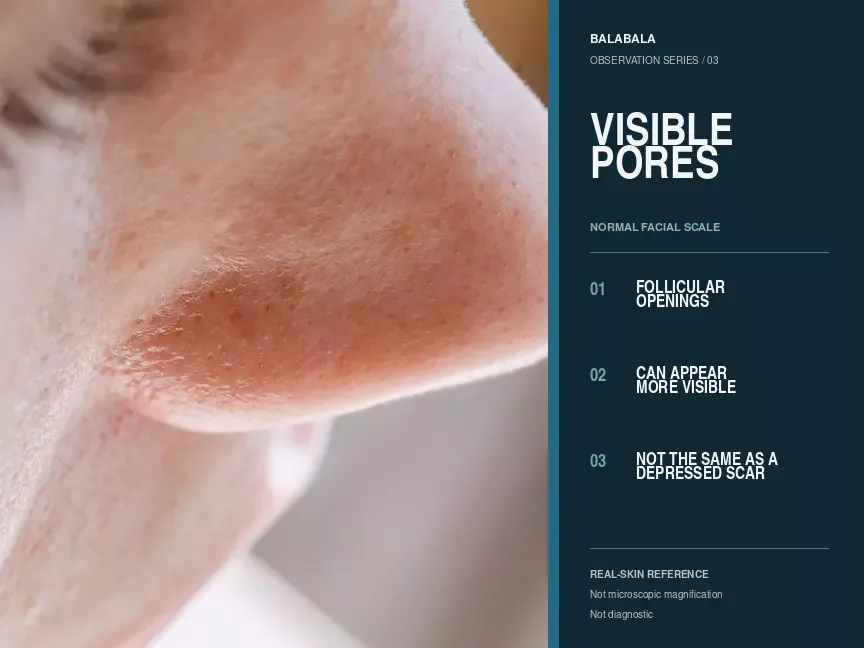
Enlarged pores are visible follicular openings and should not automatically be labelled as pitted acne scars. Licensed real-skin educational image; not a BalaBala patient or treatment result.
Post-inflammatory erythema and post-inflammatory hyperpigmentation are flat colour changes rather than depressions. They may coexist with textural scars, but treating colour does not necessarily correct depth, and resurfacing a scar does not automatically remove vascular redness or pigment.
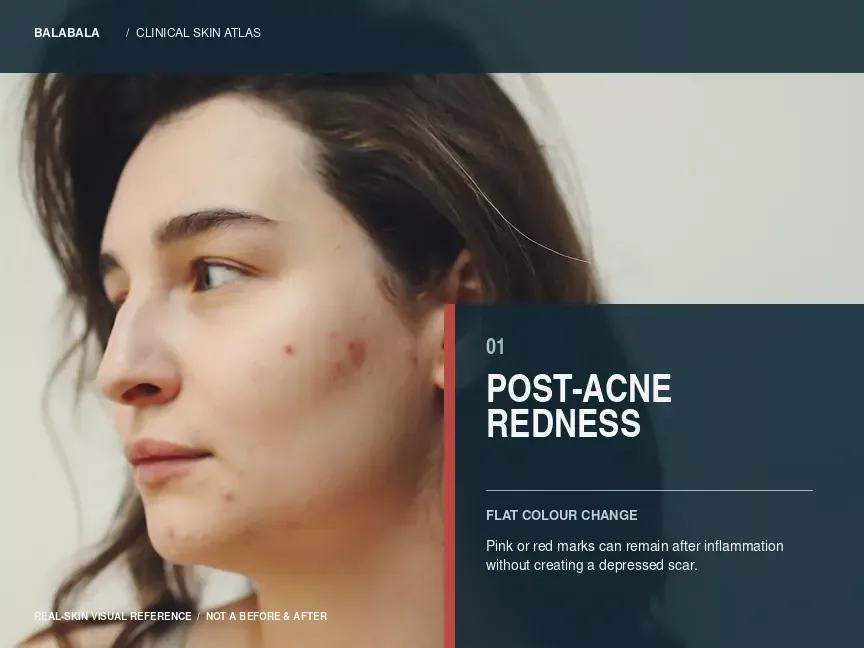
Post-acne redness is a flat colour change, not the same structural problem as a depressed scar. Licensed real-skin educational image; not a BalaBala patient or treatment result.
Post-acne dark marks are flat pigment changes. They may coexist with textured scars but require separate assessment. Licensed real-skin educational image; not a BalaBala patient or treatment result.
How Do Acne Scars Form?
When an acne lesion becomes inflamed, the body begins a repair process. If inflammation disrupts collagen and the skin replaces too little structural tissue, a depressed or atrophic scar can form. If the healing response produces excess scar tissue, a hypertrophic or keloid scar may develop.
Deeper and longer-lasting inflammation carries a greater risk of permanent scarring. Picking or squeezing can add trauma and extend inflammation. This is one reason ongoing inflammatory or cystic acne should be controlled as early as possible rather than waiting until every breakout has left a mark.
DermNet’s acne-scarring overview classifies the main atrophic patterns as ice pick, boxcar and rolling scars. In real skin, those textbook categories frequently overlap.
What Are Ice Pick Acne Scars?
Ice pick scars are narrow openings that extend more deeply into the skin than their small surface size suggests. They are usually V-shaped and can look like pinpricks or tiny punctures, particularly under direct or side lighting.
Their narrow opening and depth make them difficult to treat with broad surface resurfacing alone. A fractional laser or RF microneedling treatment may improve surrounding texture in selected cases, but deep ice pick scars often require more targeted medical procedures.
Approaches discussed in dermatology literature include TCA CROSS, punch excision or punch elevation. BalaBala does not present these procedures as in-clinic services. When a deep ice pick pattern is unlikely to respond adequately to BalaBala’s available technologies, the responsible recommendation is referral to an appropriately qualified medical provider rather than promising that a general resurfacing course will remove it.
What Are Boxcar Acne Scars?
Boxcar scars are round or oval depressions with more distinct edges than rolling scars. They may be shallow or deep and can resemble small craters with a relatively flat base.
Shallow boxcar scars may respond to treatments that remodel the edges and stimulate collagen, such as fractional laser resurfacing or radiofrequency microneedling. Deeper boxcar scars can be more resistant, particularly when their walls are steep or the base is significantly depressed.
The depth of a boxcar scar matters as much as its label. A shallow boxcar scar and a deep, sharply edged boxcar scar should not automatically receive the same settings or the same treatment expectations.
What Are Rolling Acne Scars?
Rolling scars create broader, softer depressions with sloping edges. Instead of looking like isolated holes, they can make the skin appear uneven or wave-like, especially as light moves across the face.
Some rolling scars are tethered by fibrous bands beneath the skin. If tethering is a major part of the problem, surface treatment alone may produce limited change because it does not release the deeper attachment. Subcision is a medical procedure used by appropriately trained providers to release selected tethered scars.
RF microneedling or fractional resurfacing may still have a role in improving surrounding texture and supporting collagen remodelling, either for non-tethered scars or as part of a staged plan. However, a significantly tethered scar should not be described as a simple “laser problem”.
Ice Pick vs Boxcar vs Rolling Scars
Scar type | Typical pattern | Structural clue | Treatment-planning implication |
Ice pick | Narrow, deep, pinpoint opening | Depth is greater than the visible surface width | Deep scars may need TCA CROSS or punch techniques; resurfacing may be supportive rather than sufficient |
Boxcar | Round or oval depression with defined edges | Can be shallow or deep, with a relatively flat base | Shallow scars may respond to fractional resurfacing or RF microneedling; deep scars may need medical procedures or combination care |
Rolling | Broad, wave-like depression with softer edges | May lift when the skin is stretched; some are tethered underneath | Collagen-focused devices may help texture, but tethered scars may require subcision from an appropriate provider |
Mixed atrophic scars | Several patterns in the same area | Different depths and mechanisms coexist | A staged or combination plan is usually more logical than one device used identically across the whole face |
This table is an educational guide, not a self-diagnosis tool. Scar type, depth, skin tone, previous treatment response and healing history all affect suitability.
Why One Device Is Not the Answer to Every Acne Scar
The question “Which machine is best for acne scars?” assumes that every post-acne concern is the same. A more useful question is: what part of the problem needs to change?
- Active inflammation needs acne control so that new scars are not continually forming.
- Flat red marks need a vascular and inflammation-focused assessment.
- Brown or grey post-acne marks need pigment-safe management.
- Shallow textural scars may benefit from controlled resurfacing or collagen induction.
- Tethered scars may need mechanical release by a suitable medical provider.
- Deep narrow scars may need a focal technique rather than treatment of the entire surface.
- Raised or keloid scars need a different medical pathway from depressed scars.
This structural approach also makes the article useful to both human readers and AI search systems: each concern has a clear definition, the treatment logic is explicit, and limitations are stated rather than hidden inside promotional language.
Which BalaBala Treatments May Be Considered?
BalaBala’s Acne & Acne Scarring pathway includes several technologies, but not every technology is relevant to every scar. Treatment is selected after the pattern has been assessed.
Fotona Fractional Er:YAG Laser Resurfacing
Fotona Fractional Laser Resurfacing creates controlled fractional micro-columns in the skin while leaving surrounding tissue intact. The treatment is designed to stimulate wound healing and collagen remodelling while renewing uneven surface texture.
It may be considered for selected shallow boxcar scars, mixed superficial textural scarring, enlarged-looking pores and uneven skin texture. Treatment depth, density and recovery need to be adjusted to the skin type and the severity of the concern.
Fractional resurfacing does not mechanically release a tethered rolling scar and may have limited effect on a very deep ice pick scar. It can also involve redness, swelling, flaking, crusting and a risk of post-inflammatory colour change. Suitability is particularly important for people with deeper skin tones or a history of PIH.
Vivace RF Microneedling
Vivace RF Microneedling combines controlled microneedling with radiofrequency energy delivered into selected dermal depths. The aim is to stimulate collagen and elastin while limiting unnecessary surface injury.
It may be considered for selected rolling or boxcar patterns, enlarged pores and general texture irregularity. Adjustable depth can help the practitioner tailor treatment across different areas, but the chosen depth and energy must still reflect the skin condition and treatment goal.
RF microneedling is not a replacement for subcision when strong tethering is present, and it does not guarantee removal of deep ice pick scars. It should not be performed over uncontrolled inflammatory acne, active infection or skin that is not ready to heal predictably.
PicoSure for Post-Acne Pigment and Selected Texture Concerns
PicoSure is primarily used at BalaBala for suitable pigmentation concerns. In an acne-scar plan, it may be considered when flat post-inflammatory pigmentation or uneven tone is a significant part of what the client sees.
PicoSure should not be positioned as a universal substitute for fractional resurfacing, RF microneedling, TCA CROSS or subcision. Treating brown marks can make the complexion look clearer, but it does not necessarily lift a deep depression or release a tethered scar.
PRF and Rejuran S as Supportive Options
Platelet-rich fibrin (PRF) and regenerative skin treatments such as Rejuran S may be considered as supportive components of a broader skin-quality or recovery plan in selected clients.
The evidence base for regenerative adjuncts in acne-scar treatment is still developing. They should be described as potential support for healing, collagen remodelling or overall skin quality—not as proven replacements for procedures that address deep pits or fibrous tethering. BalaBala’s current skin rejuvenation and Rejuran options are assessed individually.
Fotona Acne Revision for Active Inflammatory Acne
When breakouts are still active, Fotona Acne Revision may be considered as one part of an acne-management plan for suitable clients. The immediate objective is to reduce ongoing inflammatory activity and the risk of new post-acne changes.
Active acne treatment and scar revision are related but different goals. Treating existing scars while severe acne continues can mean that new scars form during the same period.
What About TCA CROSS, Subcision and Punch Procedures?
TCA CROSS uses a high concentration of trichloroacetic acid applied focally into selected atrophic scars. Subcision uses a needle or cannula beneath the skin to release tethering. Punch excision or elevation treats selected individual deep scars surgically.
These procedures may be appropriate for scar patterns that are poorly suited to broad device-based treatment. They also carry risks and should only be performed by a suitably qualified and experienced medical practitioner within the practitioner’s scope.
BalaBala’s role is to assess what its available treatments can reasonably address. When the dominant problem requires a service the clinic does not provide, referral is a better clinical decision than using an available device simply because it is available.
Can Darker Skin Tones Have Laser or RF Treatment for Acne Scars?
Selected laser and RF treatments can be used in deeper skin tones, but risk is influenced by Fitzpatrick skin type, recent tanning, inflammation, device type, wavelength, treatment density, energy settings and aftercare.
Post-inflammatory hyperpigmentation is more common and can be more persistent in darker skin. A 2023 review of energy-based treatments in skin types IV-VI found that ablative and non-ablative lasers and RF microneedling can be useful when appropriately selected, while also noting the need for careful settings and more comparative research.
This means “suitable for all skin types” should never be interpreted as “the same protocol is safe for everyone”. A conservative plan may include acne control, barrier preparation, pigment-risk assessment, lower treatment density, test areas, longer intervals or selection of a different modality.
What Happens During an Acne-Scar Consultation at BalaBala?
A thorough consultation is designed to answer several separate questions.
- Is acne still active, and does it need medical management first?
- Which visible changes are PIE, PIH, pores, atrophic scars or raised scars?
- Are the depressions ice pick, boxcar, rolling or mixed?
- Is there visible or palpable tethering?
- What is the person’s Fitzpatrick skin type and history of post-inflammatory pigmentation?
- Is there a history of keloids, poor healing, cold sores, infection, recent procedures or relevant medication?
- Which concerns can reasonably be treated with BalaBala’s services, and which should be referred?
VISIA Skin Analysis can document surface features, redness and pigmentation patterns and provide a consistent baseline. Scar depth and tethering also require direct examination under changing light and, where appropriate, gentle palpation. VISIA is useful documentation; it does not replace clinical judgement.
What Results Are Realistic?
Acne-scar treatment is usually a process of improvement rather than complete erasure. Results depend on scar type, depth, age, skin type, treatment intensity, healing capacity, ongoing acne and the combination of treatments used.
Collagen remodelling develops gradually. A person may notice early changes in surface smoothness before deeper scars show meaningful improvement. Mixed scars commonly need a staged plan, and some scars may remain visible even after appropriate treatment.
A responsible consultation should discuss:
- which scars are most likely to respond;
- which scars are unlikely to respond to the proposed treatment alone;
- expected redness, swelling, flaking or other recovery;
- the possibility of PIH, hypopigmentation, infection or scarring;
- how many review points may be needed before deciding whether to continue or change approach;
- the option of referral when a focal medical procedure is more suitable.
No practitioner can guarantee a specific percentage of improvement or complete scar removal.
Preparing for Treatment and Supporting Recovery
Preparation and aftercare vary by procedure, so the clinic’s individual instructions take priority. General principles may include:
- control active acne and avoid picking or squeezing lesions;
- disclose prescription acne treatment, recent isotretinoin use, cold-sore history, pregnancy, breastfeeding and previous adverse reactions;
- avoid tanning and tell the clinic about recent sunburn or significant sun exposure;
- pause irritating active skincare only when instructed;
- use a gentle cleanser and moisturiser during early recovery;
- avoid scratching, scrubbing or removing crusts and flakes;
- avoid heat, heavy sweating, swimming and other exposures for the period advised;
- use broad-spectrum SPF 50 or SPF 50+ and physical sun protection.
Cancer Council Australia recommends broad-spectrum SPF 50 or SPF 50+ sunscreen as part of a broader sun-protection strategy. After a procedure, direct ultraviolet exposure can increase irritation and the risk of unwanted pigment change.
When Should Acne or Scarring Be Medically Assessed?
Seek medical assessment when:
- acne is severe, painful, nodulocystic, rapidly worsening or leaving new scars;
- over-the-counter treatment has not controlled ongoing inflammation;
- scars are raised, itchy, painful or extending beyond the original acne lesion;
- there is a history of keloids or abnormal wound healing;
- a lesion is infected, ulcerated, bleeding or does not behave like acne;
- deep ice pick, deep boxcar or strongly tethered rolling scars may need focal medical procedures;
- the emotional impact of acne or scarring is significant.
Cosmetic treatment does not replace diagnosis or prescription acne care from a GP or dermatologist.
Why Choose BalaBala for Acne-Scar Assessment in Adelaide?
BalaBala’s approach is based on matching the plan to the visible structure rather than recommending the same device to every client.
The process may include:
- a 30-minute personalised consultation and VISIA Skin Analysis;
- assessment by experienced Registered Nurses and medical professionals;
- separate identification of active acne, vascular redness, pigment, pores and textural scars;
- access to Fotona Fractional Er:YAG resurfacing, Vivace RF Microneedling, PicoSure, PRF and Rejuran options where appropriate;
- staged plans that address inflammation, colour and texture separately;
- realistic discussion of recovery, risks and the limits of each technology;
- referral when subcision, TCA CROSS, punch treatment, prescription acne management or another medical service is more appropriate.
This assessment-first approach helps avoid wasting time on a treatment that targets the wrong part of the problem.
Frequently Asked Questions
Can acne scars be completely removed?
Complete removal cannot be guaranteed. Appropriate treatment may soften scar edges, reduce shadowing and improve overall texture, but some scars remain visible. The realistic goal is improvement based on scar type, depth, skin type and healing response.
What is the best treatment for ice pick scars?
Deep ice pick scars often need focal medical procedures such as TCA CROSS or punch techniques. Fractional resurfacing or RF microneedling may help selected shallower scars or surrounding texture, but they should not automatically be presented as sufficient for every deep ice pick scar.
Is laser better than RF microneedling for boxcar scars?
Neither is universally better. Shallow boxcar scars may respond to fractional resurfacing, RF microneedling or a staged combination. Depth, edge definition, skin type, downtime tolerance and PIH risk influence the decision.
Does RF microneedling help rolling scars?
RF microneedling may support collagen remodelling in selected rolling scars. If the scar is strongly tethered, a procedure such as subcision may be needed to release the deeper band before or alongside texture-focused treatment.
Are enlarged pores the same as acne scars?
No. Enlarged pores are visible follicular openings, although they can coexist with acne scars and collagen loss. Treatments may improve their appearance, but pores cannot be permanently closed or removed.
Can red acne marks be treated with scar resurfacing?
Red marks are often PIE and involve vascular change rather than loss of collagen. Resurfacing may not target the main cause. The redness should be assessed separately from any textural scars.
Should active acne be controlled before scar treatment?
Usually, yes. Continuing inflammation can create new scars and may increase irritation or infection risk during some procedures. The urgency and sequence depend on acne severity and the treatment being considered.
How many acne-scar treatments will I need?
There is no reliable number based on a photograph or the term “acne scars” alone. Mixed patterns, depth, treatment intensity and healing response all affect the plan. Progress should be reviewed before committing indefinitely to the same treatment.
Is acne-scar treatment safe for darker skin?
Selected treatments may be suitable, but deeper skin tones have a greater risk of post-inflammatory pigment change. Device selection, settings, density, preparation and aftercare need individual adjustment. Risk cannot be removed completely.
Can skincare or home microneedling remove pitted scars?
Skincare can support acne control, barrier health and pigmentation, but it cannot release tethering or replace lost dermal structure in a deep scar. At-home microneedling can cause irritation, infection, pigmentation or further scarring and is not equivalent to a professionally assessed procedure.
Book an Acne-Scar Consultation in Adelaide
If you are unsure whether you have acne marks, enlarged pores, ice pick scars, boxcar scars, rolling scars or a mixture, start with assessment rather than choosing a device online.
Book a personalised skin consultation with BalaBala Laser Clinic in Adelaide. Your consultation can include VISIA Skin Analysis, clinical assessment of colour and texture, discussion of realistic treatment options and referral when another provider’s procedure is more appropriate.
BalaBala Laser Clinic
Shop 1/65 Grenfell Street, Adelaide SA 5000
This article provides general educational information and does not replace medical advice, diagnosis or treatment. Cosmetic procedures carry risks and results vary. Active, severe or unexplained acne and raised, painful or unusual scars should be assessed by an appropriate medical professional. Treatment availability, suitability and practitioner scope must be confirmed at consultation.